Album Review–Metanoia
Falling You and the Quiet Art of Transformation: When Sound Becomes a Threshold
There are albums that are to be heard, and there are albums that are to be entered. Metanoia, the latest release from John Michael Zorko under his long-running project Falling You, belongs unmistakably to the latter. From its opening moments, the album unfolds not as a collection of discrete songs but as an emotional terrain shaped by memory, loss, beauty, and renewal. True to the meaning of its title, Metanoia moves with the spirit of inward turning: a gradual, sometimes painful, sometimes luminous reorientation of the heart.
Metanoia situates itself within New Age and contemporary instrumental music, yet consistently reaches beyond genre boundaries. Drawing from ambient, dream pop, and cinematic post-rock, Zorko constructs a sound world where time stretches, textures breathe, and emotion emerges slowly, often wordlessly. This is music that does not rush to explain itself. Instead, it invites patience, presence, and emotional openness.
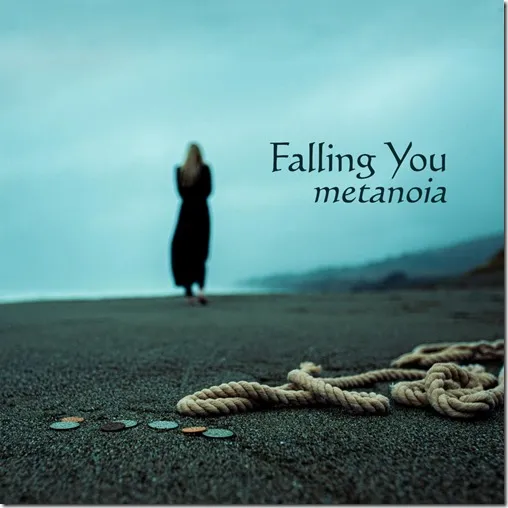
The Falling You Aesthetic
Falling You has, since its founding in 1995, occupied a distinctive space in ambient and ethereal music. At the center of the project is John Michael Zorko, a composer and sound designer based in the San Francisco Bay Area, whose work is defined by restraint, atmosphere, and emotional precision. Rather than foregrounding himself as a solo auteur, Zorko approaches Falling You as a collaborative vessel. Each album becomes a meeting place where his instrumental architectures are animated by the voices and sensibilities of carefully chosen guest artists.
Metanoia continues this tradition with exceptional clarity. Zorko’s role as composer, sound sculptor, and emotional curator is evident throughout. His synths, guitars, and noise elements form slow-moving harmonic environments that feel less like accompaniment and more like emotional weather systems. Within these spaces, guest vocalists appear not as lead narrators, but as presences—human traces moving through vast sonic landscapes.
An Album as Emotional Environment
What distinguishes Metanoia is its sense of cohesion. Across eleven tracks, the album sustains a consistent emotional temperature while allowing each piece its own internal gravity. There are no abrupt contrasts or performative climaxes here. Instead, Zorko favors slow arcs, gradual evolutions, and subtle shifts in texture and tone. The result is an album that feels lived in rather than constructed.
Atmospheric synths form the album’s backbone, often layered in wide, cinematic washes that suggest open skies and distant horizons. Textured guitars appear like faint signals, sometimes melodic, sometimes abstract, always emotionally charged. Sound design plays a crucial role, adding depth and dimensionality without overwhelming the core emotional thread. Silence, too, is treated with respect; space is allowed to speak.
Vocals across the album are used sparingly and intentionally. Without relying on explicit lyrical interpretation, their power lies in timbre, phrasing, and emotional delivery. Each voice enters as if stepping into an already existing emotional field, shaping it momentarily before receding.
Track-by-Track Analysis
1. Throw the Stone
The album opens with a sense of suspended motion. Colleen Segale’s vocal presence arrives gently, hovering within Zorko’s ambient framework. The track feels like an initiation, setting the emotional tone of vulnerability and release that carries forward.
2. Demiurge (Momento Eorum)
Jennifer Wilde’s voice adds an elegiac quality here, weaving through dense layers of sound. The piece feels ceremonial, as though marking a passage or remembering something just out of reach. There is a quiet gravity to the way sound unfolds.
3. Flesh to Tree
Courtney Grace brings a haunting, rooted presence to this track. The music feels organic and grounded, with a slow, deliberate pacing that suggests transformation through endurance rather than force.
4. Alcyone
At over ten minutes, this is one of the album’s most expansive pieces. Dru Allen’s shimmering vocal textures drift through vast ambient spaces, creating a sense of cosmic longing. The track unfolds patiently, rewarding deep listening.
5. Ari’s Song
Slim Heilpern’s harmonica introduces an unexpected yet fitting element. Its human breath adds warmth and intimacy, grounding the surrounding atmosphere in something tactile and immediate.
6. Inside the Whake
This piece leans more heavily into abstract sound design. Guitars and synths blur into one another, creating a sense of interiority and emotional enclosure.
7. Ariadne
Courtney Grace returns with a vocal performance that feels both searching and resolute. The track carries mythic undertones without ever becoming illustrative, allowing emotion to lead interpretation.
8. They Give Me Flowers
Erica Mulkey’s voice and cello, combined with Shikhee’s modular synths, create one of the album’s most texturally rich moments. The piece feels ceremonial, poised between grief and grace.
9. (trying to weave) A Thread Of Happiness (from one day to the next)
Jennifer Wilde reappears in a tender, restrained closing movement. The track feels intimate and fragile, emphasizing continuity and quiet hope.
10. Constellations
Amelia Hogan’s vocals float through layered atmospheres that suggest distance and connection simultaneously. The music feels expansive yet personal.
11. Philomena
Closing the album, Anji Lum’s vocal presence, supported by Ryan Lum’s guitar and percussion, offers a sense of gentle resolution. Rather than closure, the track provides acceptance—a soft landing after a long emotional journey.
Genre, Identity, and Artistic Voice
While Metanoia is filed under New Age and contemporary instrumental music, it resists easy categorization. Ambient and dream pop influences are evident, as are elements of cinematic post-rock, yet none dominate. Instead, the album’s identity emerges through emotional coherence rather than stylistic allegiance.
What makes Metanoia unique is its refusal to dramatize transformation. There is no spectacle here, no forced catharsis. Change is portrayed as slow, layered, and deeply personal. This approach aligns beautifully with the album’s title and conceptual core.
Take Away
Ultimately, Metanoia succeeds because it trusts the listener. It does not explain, instruct, or demand. It offers space—space to feel, to remember, to sit with complexity. In an era of constant noise and immediacy, Falling You presents something increasingly rare: an album that unfolds at the pace of inner life.
For listeners drawn to ambient, ethereal, and emotionally resonant music, Metanoia is not simply recommended; it is essential. This is an album that does not end when the final track fades, but continues to resonate quietly, like a change that has already begun to take root.
